
Executive AI Control Begins With Strategic Clarity.
AI adoption at the executive level is rarely a technology problem.
It is a leadership, capital allocation, and strategic alignment decision.
The scenarios below reflect recurring executive patterns observed across advisory engagements — particularly in organizations operating under growth, investor, or competitive pressure.
These scenarios reflect leadership challenges organizations encounter when AI adoption accelerates faster than governance and strategic clarity.

Fragmented AI Adoption Across Departments
AI initiatives emerge across functions as teams pursue efficiency or competitive advantage — often without coordinated executive oversight.
Observed Risk Pattern
- Multiple AI pilots without shared governance
- Vendor-driven experimentation without strategic alignment
- Overlapping tools and rising cost structures
- Limited visibility into enterprise-wide impact
Structured Executive Response
- Establish enterprise-level AI governance
- Define capital allocation guardrails
- Align AI initiatives with corporate strategy
- Implement governance and performance oversight
Executive Outcome
AI initiatives become coordinated strategic capabilities rather than fragmented departmental experiments.
AI Adoption Under Board and Investor Pressure
Executive Context
Boards increasingly expect leadership teams to demonstrate a credible AI strategy tied to long-term growth and operational efficiency.
Observed Risk Pattern
- Rapid AI pilots without strategic oversight
- Capital deployment ahead of governance structures
- Narrative-driven investment decisions
- Escalating technology spending without defined outcomes
Structured Executive Response
- Define measurable value before capital deployment
- Establish board-level AI governance frameworks
- Sequence AI exploration into strategic investment phases
- Create structured executive oversight cadence
Executive Outcome
AI adoption strengthens credibility with investors and boards while preserving strategic control.


Data-Rich but Decision-Poor Organizations
Executive Context
Organizations often accumulate extensive data while leadership decision-making remains fragmented or reactive.
Observed Risk Pattern
- Data infrastructure without executive ownership
- Dashboards without decision accountability
- Strategy disconnected from operational insights
- AI experimentation without defined business leverage
Structured Executive Response
- Identify high-impact executive decision points
- Align AI initiatives with strategic KPIs
- Create leadership-level data accountability
- Establish structured performance review cycles
Executive Outcome
AI becomes embedded in strategic decision-making, improving clarity, speed, and measurable outcomes.
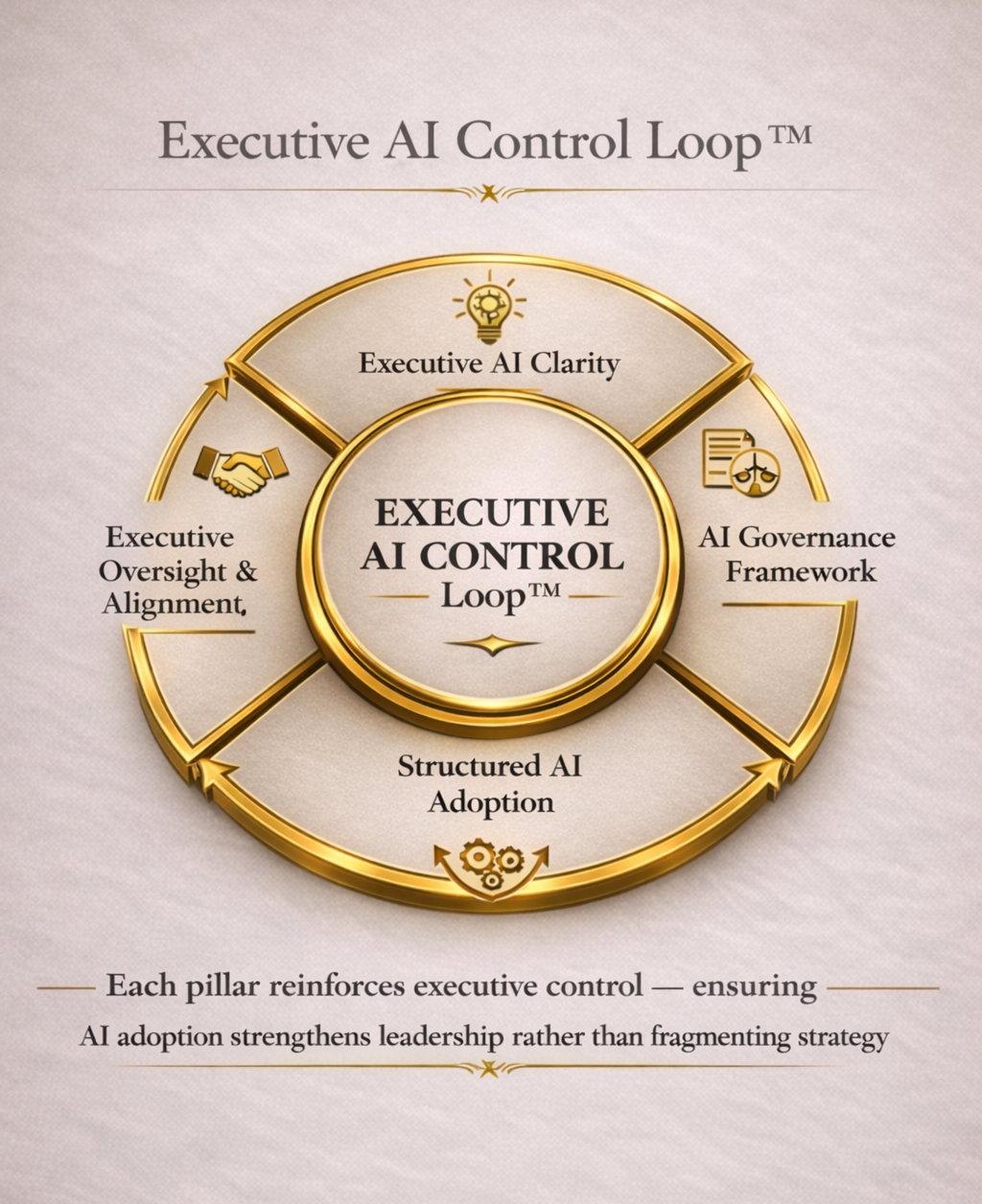
Structured AI Adoption Is Not About Tools — It Is About Executive Control.
Successful AI programs are not built around technology.
They are built around leadership architecture.
Horizon SPI introduces the Executive AI Control Loop™ — a structured executive framework designed to align governance, capital discipline, strategy, and measurable performance outcomes.
AI leadership begins when executive structure replaces experimentation.