
AI Adoption Is a Capital Allocation Decision
Why AI investment decisions must be governed like capital allocation — not technology experimentation.
Artificial intelligence is quickly becoming one of the largest capital investment cycles of the modern enterprise. Organizations are committing billions to AI capabilities, tools, and infrastructure in pursuit of productivity gains and competitive advantage.
Yet despite unprecedented levels of investment, most companies are struggling to translate AI spending into measurable enterprise value.
The core issue is not technological capability. It is strategic governance.
Most organizations still treat AI adoption as a technology initiative rather than what it actually represents: a capital allocation decision that reshapes how the enterprise operates, competes, and makes decisions.
Executive Perspective — Horizon SPI
Executive Summary
Artificial intelligence has rapidly become one of the largest investment priorities in modern enterprise strategy. Yet while AI spending continues to accelerate, value realization remains stubbornly limited. The problem is not technological capability — it is strategic governance.
Most organizations treat AI adoption as a technology initiative rather than as a capital allocation decision. As a result, capital is deployed through fragmented pilots, disconnected experimentation, and procurement-driven initiatives rather than through disciplined investment frameworks.
The organizations generating meaningful AI returns are approaching the challenge differently. They treat AI not as software deployment but as enterprise transformation — governed with the same rigor applied to major capital investments, mergers, or infrastructure programs.
The Investment Illusion
Enterprise AI investment has reached unprecedented scale.
U.S. companies alone are expected to spend more than $300 billion on AI in 2025, and recent executive surveys show that 85% of organizations increased AI investment in the past year, with more than 90% planning further increases.
Yet the value delivered from these investments remains strikingly limited.
Research from McKinsey & Company finds that only 1% of companies describe themselves as “mature” in AI deployment, meaning that AI is fully embedded in workflows and delivering measurable business outcomes.
The implication is clear: organizations are deploying capital far faster than they are generating returns.
This gap is often described as a technology challenge. In reality, it is a strategy problem.
The Misclassification Problem
At the root of the issue is a simple but consequential misclassification.
Most organizations treat AI as a technology procurement decision rather than a capital investment decision.
AI initiatives are frequently routed through IT budgets, innovation teams, or digital transformation offices. These structures are well suited to deploying software tools, but they are poorly designed to govern investments that fundamentally reshape operating models, decision architectures, and workforce structures.
Research from Boston Consulting Group shows that 74% of companies struggle to achieve and scale value from AI initiatives. Executives often describe adoption as a competitive imperative driven more by fear of falling behind than by a clearly articulated investment thesis.
This dynamic leads organizations to launch large numbers of experimental initiatives without portfolio discipline or strategic prioritization.
The result is predictable: activity expands while value remains elusive.
Governance Failures at Scale
When AI investments bypass enterprise governance structures, systemic risks begin to emerge.
Research from Gartner projects that 60% of AI projects will fail to meet their value targets by 2027 due largely to fragmented governance and weak alignment with business strategy.
Several recurring patterns appear across organizations:
Organizational fragmentation
AI development, data ownership, risk oversight, and operational deployment are often distributed across multiple departments with no integrating authority.
Compliance mistaken for governance
Many organizations rely on regulatory compliance frameworks to manage AI. Compliance addresses risk containment, not strategic value creation.
Limited board engagement
Analysis referenced by Ernst & Young indicates that only a small minority of large companies report formal AI education or oversight at the board level.
Proliferation of disconnected pilots
AI experimentation often runs far ahead of governance infrastructure, leaving organizations with dozens of pilots but few scalable systems.
Together, these dynamics create what might be called governance-free AI adoption — a condition in which capital is deployed faster than strategic oversight evolves.
The Economics of AI ROI
The consequences of governance gaps are increasingly measurable.
Studies from Deloitte show that most organizations require two to four years to realize returns from typical AI use cases — significantly longer than the payback periods expected from conventional enterprise technology investments.
Only a small fraction of organizations report measurable returns within the first year.
At the same time, large corporations are beginning to formally disclose operational risks associated with AI systems, including hallucinations, bias, and decision inaccuracies.
These developments reinforce a central reality: AI investments carry material operational and strategic risk alongside potential economic value.
Managing that tradeoff requires disciplined governance.
What AI Leaders Do Differently
Organizations generating meaningful returns from AI exhibit a strikingly different investment pattern.
Rather than launching large numbers of exploratory pilots, leading companies concentrate resources on a smaller portfolio of strategically prioritized initiatives.
Research from Boston Consulting Group highlights a common resource allocation pattern among high-performing organizations:
10% investment in algorithms
20% investment in technology and data infrastructure
70% investment in people, operating processes, and organizational transformation
In other words, the majority of AI value creation occurs not in software development but in organizational redesign.
High-performing organizations also embed AI governance directly into enterprise strategy oversight rather than treating it as a parallel technology program.
The Strategic Imperative for Executives and Boards
Management research across multiple institutions is converging on the same structural insight:
AI governance must be integrated into enterprise capital governance.
AI adoption requires the same disciplines applied to any major strategic investment:
- A clearly defined investment thesis
- Opportunity cost analysis
- Portfolio prioritization
- Governance accountability
- Performance measurement aligned with realistic return horizons
Executives who approach AI primarily as a technology decision risk repeating a familiar historical pattern.
As one analogy frequently used by researchers suggests: adopting AI without restructuring operations is similar to introducing electricity into factories designed for steam power without redesigning the production line.
The technology may change immediately.
The productivity gains only appear when the organization itself is redesigned.
The research and experience across organizations point to a consistent conclusion: AI investment requires disciplined governance. The following framework summarizes how executives should approach AI capital allocation.
Horizon SPI AI Capital Governance Model
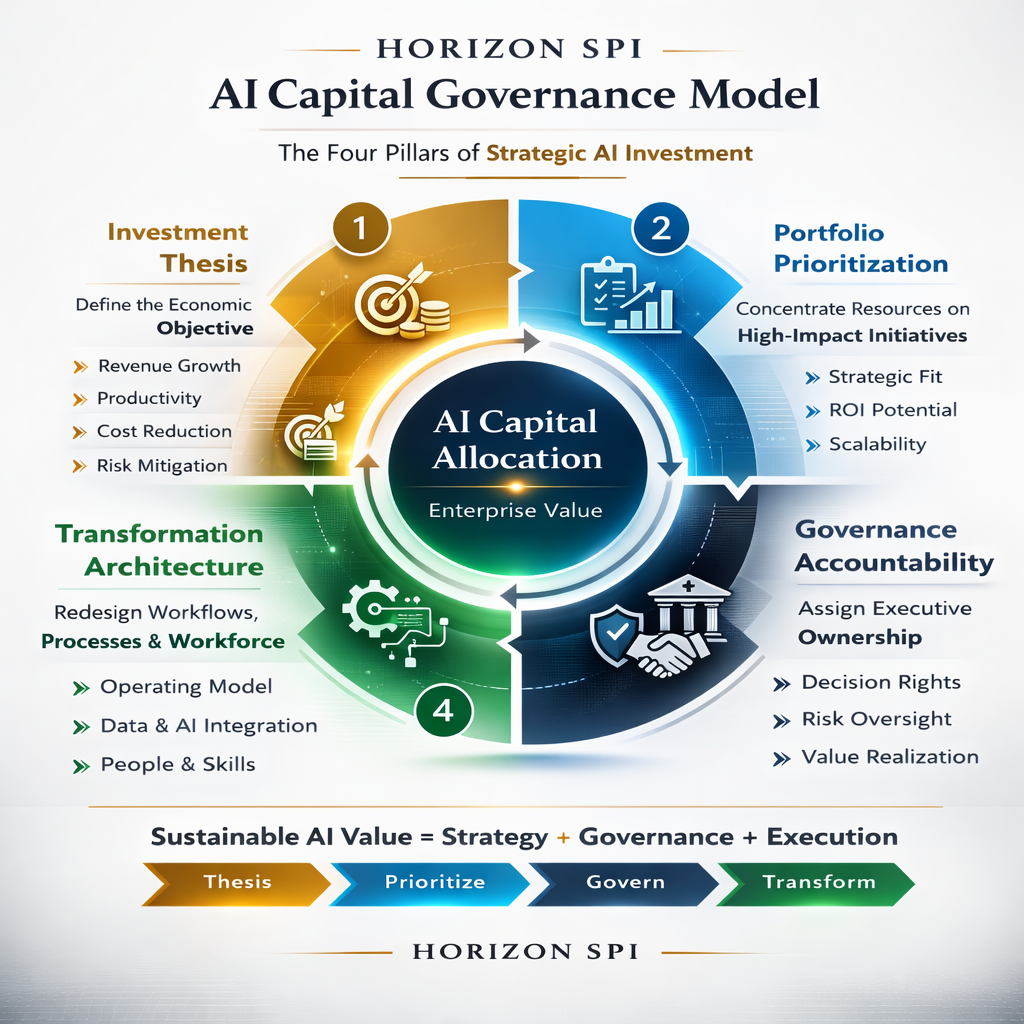
Figure — Horizon SPI AI Capital Governance Model
Artificial intelligence investments should be governed with the same discipline applied to major enterprise capital programs. The Horizon SPI AI Capital Governance Model provides a practical structure for executives to evaluate, prioritize, and govern AI investments.
Investment Thesis
Every AI initiative must have a clearly defined business objective—revenue growth, productivity improvement, cost reduction, or risk mitigation.
Portfolio Prioritization
Organizations should concentrate resources on a small number of high-impact initiatives rather than running dozens of disconnected pilots.
Governance Accountability
Executive leadership and boards must define ownership for AI decisions, operational risk, and value realization.
Transformation Architecture
Most AI value is realized through redesigned workflows, decision processes, and workforce capabilities—not technology deployment alone.
Executive AI Capital Allocation Architecture
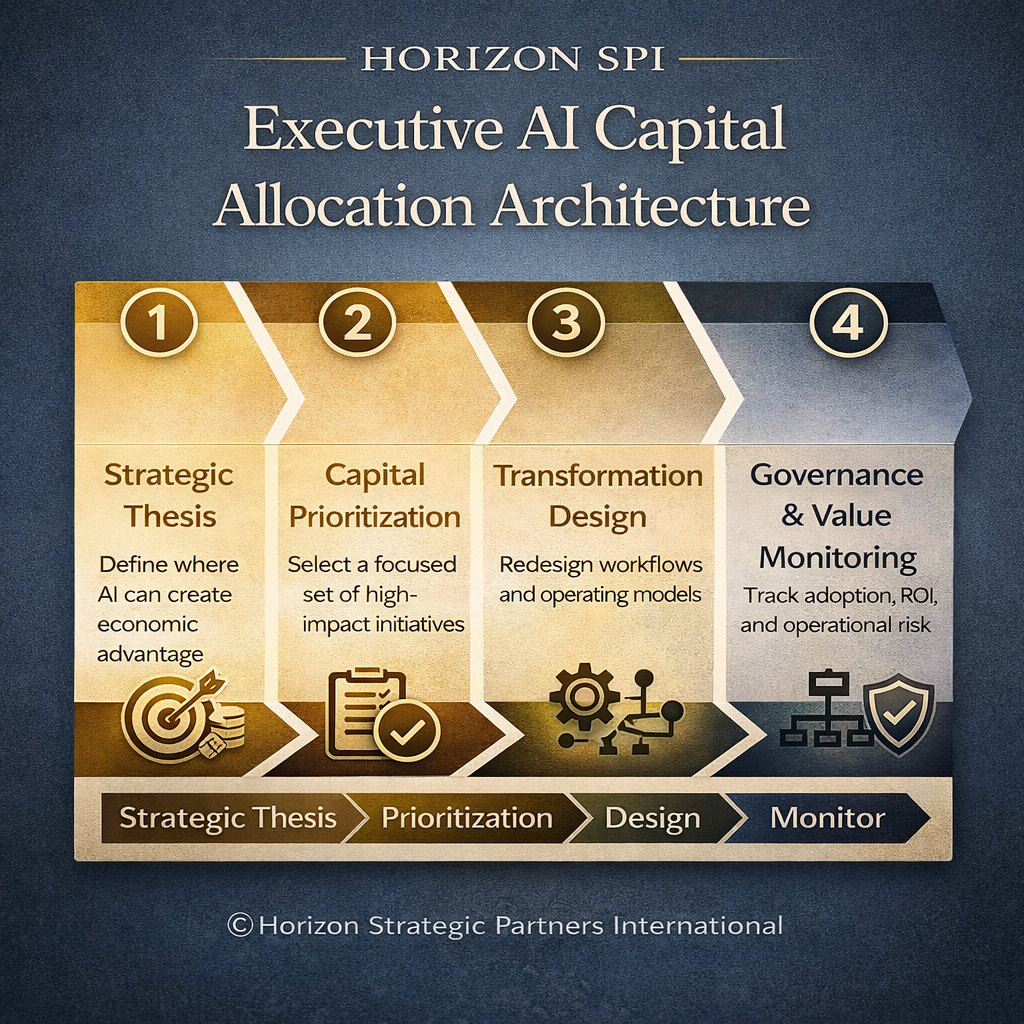
Figure — Executive AI Capital Allocation Architecture
AI investment should follow a disciplined executive decision structure similar to other major capital commitments. The architecture below outlines the sequence executives should follow when allocating capital to AI initiatives.
Step 1 — Strategic Thesis
Define where AI can create economic advantage for the organization.
Step 2 — Capital Prioritization
Select a focused set of high-impact initiatives with clear investment logic.
Step 3 — Transformation Design
Redesign workflows, operating models, and decision processes around AI capabilities.
Step 4 — Governance and Value Monitoring
Track adoption, ROI, and operational risk through executive governance structures.
Closing Perspective
Artificial intelligence will undoubtedly reshape competitive dynamics across industries. But the organizations that capture its value will not be those experimenting the fastest.
They will be those governing it the most strategically.
AI adoption is not primarily a technology decision.
It is a capital allocation decision—and it should be governed accordingly.
Advisory Note
Horizon SPI works with executive teams and boards to design practical frameworks for AI governance, strategic prioritization, and enterprise transformation.
Organizations evaluating how AI investments should be structured, governed, and scaled can schedule a 45-minute executive strategy session to explore how these frameworks apply to their operating environment.